2  Data

2.1 Description

This project will use the Swissvotes dataset, the definitive scholarly resource on Swiss federal referendums, which is curated and maintained by the Année Politique Suisse at the University of Bern. The data is collected continuously and updated after every voting Sunday. The dataset contains all votes from 1848 up until the latest ones in late 2025.

The dataset is provided as a single, wide-format CSV file containing 706 rows of data and several hundred columns, ranging from basic vote characteristics and national outcomes to granular cantonal results and party positions. The data accounts for 659 distinct votes, comprising 241 Popular Initiatives, 217 Optional Referendums and 201 Mandatory Referendums. There are also 47 rows representing counter-proposals (43) or tie-breaker questions (4), which are linked to a primary vote but tracked separately. The final 6 rows represent upcoming votes scheduled for 2026, which currently lack outcome data.

A preliminary review confirms that missing values are coded inconsistently as full stops (.), empty cells (““), or numerical placeholders (”9999”). These will be harmonized during the data cleaning process. Crucially, as the “Missing Data Analysis” section will demonstrate, this missingness is not random but systematic. It reflects the historical evolution of record-keeping. Granular metrics such as campaign data or parliamentary vote tallies were simply not recorded in the 19th century. This constraint requires a methodological split. While legislative trends can be analyzed over the full 177-year period, investigations into campaign dynamics (e.g., advertising) will be restricted to the modern era where data is complete.

The dataset is publicly available under a Creative Commons Attribution 4.0 International License. While Swissvotes provides an exhaustive bibliography of its official sources, it does not publish its raw aggregation code. This analysis therefore relies on the accuracy of the provided data.

The dataset and all related documentation are publicly available and sourced from the following links of Swissvotes:

2.2 Setup

This section loads the necessary tools and defines the visual style.

Code
knitr::opts_chunk$set(echo = TRUE, warning = FALSE, message = FALSE)

required_packages <- c(
  "tidyverse",
  "janitor",  
  "scales",      
  "ggrepel",     
  "ggalluvial",
  "RColorBrewer",
  "lubridate",
  "gridExtra",
  "tidyr"
)

install_and_load <- function(packages) {
  new_packages <- packages[!(packages %in% installed.packages()[, "Package"])]
  if (length(new_packages) > 0) {
    install.packages(new_packages)
  }
  invisible(lapply(packages, library, character.only = TRUE))
}

install_and_load(required_packages)

theme_swiss <- function() {
  theme_minimal(base_family = "Arial") +
    theme(
      plot.title = element_text(face = "bold", size = 16, color = "#2c3e50"),
      plot.subtitle = element_text(size = 12, color = "#7f8c8d"),
      axis.title = element_text(face = "bold", size = 10),
      legend.position = "bottom",
      panel.grid.minor = element_blank(),
      strip.text = element_text(face = "bold", hjust = 0)
    )
}
theme_set(theme_swiss())

2.3 Data Preparation

This section downloads the latest dataset from Swissvotes.

Code
DATA_DIR <- "data"
if (!dir.exists(DATA_DIR)) dir.create(DATA_DIR)

DATA_URL <- "https://swissvotes.ch/page/dataset/swissvotes_dataset.csv"
CODEBOOK_URL <- "https://swissvotes.ch/page/dataset/codebook-de.pdf"
REFS_URL <- "https://swissvotes.ch/page/dataset/kurzbeschreibung-de.pdf"

download_if_missing <- function(url, dest_path) {
  if (!file.exists(dest_path)) {
    download.file(url, dest_path, mode = "wb")
  }
}
download_if_missing(CODEBOOK_URL, file.path(DATA_DIR, "codebook.pdf"))
download_if_missing(REFS_URL, file.path(DATA_DIR, "references.pdf"))

file_pattern <- "DATASET.*\\.csv"
local_files <- list.files(DATA_DIR, pattern = file_pattern, full.names = TRUE)

if (length(local_files) > 0) {
  file_info <- file.info(local_files)
  target_file <- rownames(file_info)[which.max(file_info$mtime)]
  message(paste("Loading latest local file:", basename(target_file)))
} else {
  current_date_str <- format(Sys.Date(), "%d-%m-%Y") 
  new_filename <- paste0("DATASET CSV ", current_date_str, ".csv")
  target_file <- file.path(DATA_DIR, new_filename)
  
  message(paste("Downloading fresh dataset to:", new_filename))
  download.file(DATA_URL, target_file, mode = "wb")
}

votes <- read_delim(target_file, delim = ";", na = c(".", "", "9999"), show_col_types = FALSE) |>
  clean_names() |>
  mutate(
    date_vote = as.Date(datum, format = "%d.%m.%Y"),
    start_date = dmy(dat_start),
    submit_date = dmy(dat_submit),
    days_collected = as.numeric(difftime(submit_date, start_date, units = "days")),
    year = year(date_vote),
    across(where(is.character), ~ str_remove_all(., "'")),
    volkja_proz = as.numeric(volkja_proz),
    inserate_total = as.numeric(inserate_total),
    inserate_jaanteil = as.numeric(inserate_jaanteil),
    mediaton_tot = as.numeric(mediaton_tot),
    bet = as.numeric(bet),
    nrja = as.numeric(nrja),
    nrnein = as.numeric(nrnein),
    ktjaproz = as.numeric(ktjaproz),
    unter_quorum = as.numeric(unter_quorum), 
    unter_g = as.numeric(unter_g), 
    sammelfrist = as.numeric(sammelfrist)
  )

2.4 Missing Value Analysis

Code
var_map <- c(
  "volkja_proz"       = "Popular Vote % (volkja_proz)",
  "ktjaproz"          = "Cantonal Vote % (ktjaproz)",
  "annahme"           = "Outcome (annahme)",
  "inserate_total"    = "Total Ads Volume (inserate_total)",
  "inserate_jaanteil" = "Share of 'Yes' Ads (inserate_jaanteil)",
  "mediaton_tot"      = "Media Tone (mediaton_tot)",
  "bet"               = "Voter Turnout (bet)",
  "nrja"              = "National Council Yes (nrja)",
  "nrnein"            = "National Council No (nrnein)",
  "d1e1"              = "Policy Domain (d1e1)",
  "rechtsform"        = "Legal Form (rechtsform)",
  "sammelfrist"       = "Collection Deadline (sammelfrist)",
  "dat_start"         = "Start Date (dat_start)",
  "dat_submit"        = "Submission Date (dat_submit)"
)

missing_data <- votes |>
  select(year, all_of(names(var_map))) |>
  
  mutate(across(all_of(names(var_map)), ~ case_when(
    as.character(.) %in% c(".", "", "9999") ~ NA_character_, 
    is.na(.) ~ NA_character_,                                 
    TRUE ~ as.character(.)                                    
  ))) |>
  
  pivot_longer(
    cols = -year,
    names_to = "code",
    values_to = "value"
  ) |>
  mutate(
    is_missing = is.na(value),
    variable_label = recode(code, !!!var_map)
  )

missing_summary <- missing_data |>
  group_by(variable_label) |>
  summarize(
    pct_missing = mean(is_missing),
    count_missing = sum(is_missing)
  ) |>
  arrange(pct_missing)

ordered_levels <- missing_summary$variable_label

missing_summary <- missing_summary |>
  mutate(variable_label = factor(variable_label, levels = ordered_levels))

heatmap_data <- missing_data |>
  mutate(decade = floor(year / 10) * 10) |>
  group_by(decade, variable_label) |>
  summarize(pct_missing = mean(is_missing), .groups = "drop") |>
  complete(decade = seq(from = 1840, to = 2020, by = 10), variable_label) |>
  mutate(variable_label = factor(variable_label, levels = ordered_levels))

p1 <- ggplot(missing_summary, aes(x = pct_missing, y = variable_label)) +
  geom_bar(stat = "identity", fill = "#E74C3C", alpha = 0.8, width = 0.7) + 
  
  geom_text(aes(label = percent(pct_missing, accuracy = 1)), 
            hjust = -0.1, size = 3.5, color = "grey30") +
  
  scale_x_continuous(labels = percent_format(), limits = c(0, 1.1)) +
  
  labs(
    title = "Missingness by Variable (Overall)",
    subtitle = "Percentage of votes with missing values (treating '9999', '.', and ' ' as missing)",
    x = "% Missing",
    y = NULL
  ) +
  theme_minimal() +
  theme(
    plot.title = element_text(face = "bold", size = 14),
    panel.grid.major.y = element_blank(),
    axis.text.y = element_text(size = 10)
  )

p2 <- ggplot(heatmap_data, aes(x = decade, y = variable_label, fill = pct_missing)) +
  
  geom_tile(color = "white", size = 0.2) +
  
  scale_fill_gradient(
    low = "white", 
    high = "#a50f15",
    na.value = "grey90", 
    labels = percent_format(), 
    name = "% Missing"
  ) +
  
  scale_x_continuous(breaks = seq(1840, 2020, by = 20)) +
  
  labs(
    title = "Structural Missingness: The Timeline",
    subtitle = "Red = Missing Data. White = Data Present. Grey = No Votes Held (e.g., 1850s).",
    x = "Decade",
    y = NULL
  ) +
  theme_minimal() +
  theme(
    legend.position = "bottom",
    legend.key.width = unit(1.5, "cm"),
    panel.grid = element_blank(),
    axis.text.y = element_text(size = 10)
  )

grid.arrange(p1, p2, nrow = 2, heights = c(1, 1.2))
Missing Data Analysis: Frequency and Historical Patterns

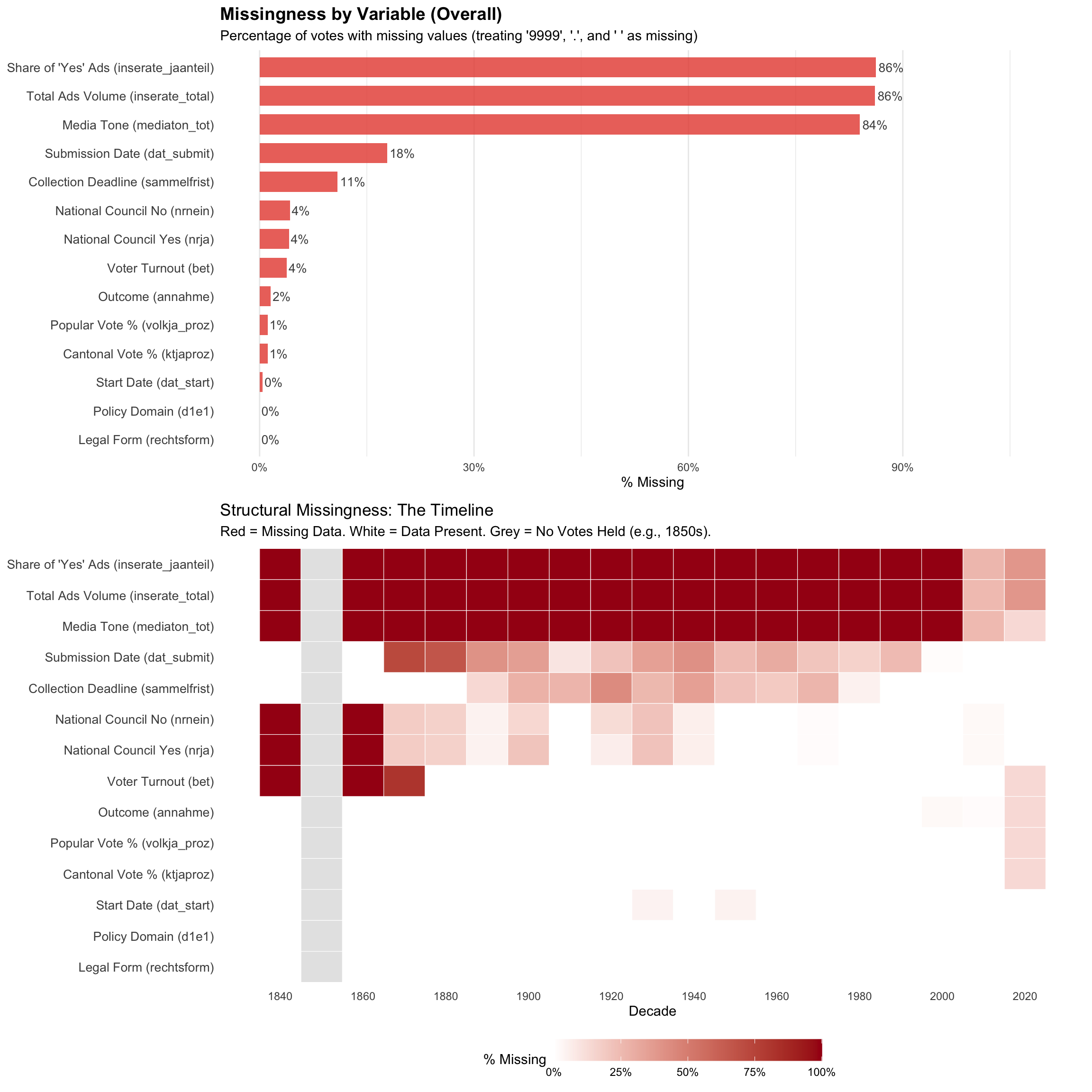
To ensure the robustness of our analysis, we must understand the limitations of the Swissvotes dataset. While the database covers a massive timespan (1848–Present), data collection standards have evolved significantly over 177 years. The visualization highlights three distinct categories of “missingness”:

  1. The “Modern Metric” Gap (related to Campaign Data): The massive red blocks at the top of the heatmap (Ads and Media Tone) represent a methodological boundary, not data loss. Systematic tracking of advertising volume (inserate_total) and media sentiment (mediaton_tot) is a recent innovation in political science. Consequently, this data is completely absent prior to the year 2000.

  2. The “Bureaucratic Evolution” (related to Turnout & Parliament): The middle part of the heatmap visualizes the professionalization of the Swiss state. In the early decades of the Federation (1848–1870s), record-keeping was less standardized.

  • Turnout (bet): The Federal Chancellery did not systematically record national voter turnout percentages until the late 19th century, explaining the dark red block on the left.

  • Parliamentary Recommendations (nrja/nrnein): Similarly, exact vote counts in the National Council are often missing for early votes, likely because decisions were taken by voice vote or records from the early Official Bulletin are incomplete. By 1900, these variables turn white, indicating the establishment of rigorous modern record-keeping.

  1. Logical & Structural Gaps
  • Signatures: The missingness in mobilization dates (dat_submit) is largely structural. Mandatory Referendums (constitutional amendments) are automatically triggered by Parliament and do not require signature collection. Therefore, they logically have no dates related to signature collection.

  • The 1850s Void: The grey column for the 1850s correctly indicates that no federal votes were held during this decade, a unique period of legislative quiet in Swiss history.

  • The “Future” Artifact: The faint red shading in the 2020s for outcome variables (e.g., annahme) represents placeholder rows for upcoming votes scheduled in 2026. These entries exist in the database but naturally lack results.

Despite these specific gaps, the core data remains remarkably resilient. The fundamental variables required for our historical analysis (the Legal Form, the Policy Domain, and most importantly, the Outcome) are present for nearly 100% of cases (white rows). This confirms that while we lack contextual data (ads/turnout) for the 1800s, the historical record of decisions made is complete and reliable.